Thinking About LASIK? What Your Eye Tests Reveal About Your Suitability
On this page

Your spectacle power alone cannot tell you whether LASIK is suitable for you. The decision also depends on your cornea, tear film and overall eye health. Before LASIK surgery , an ophthalmologist checks whether reshaping your cornea, the clear front surface of your eye, can improve your vision without creating an unacceptable risk. These tests explain why two people with similar prescriptions may receive different advice.
Is Your Spectacle Power Stable?
A refraction test measures the prescription needed to bring your vision into focus. Your doctor compares this result with earlier prescriptions to check whether your power has changed.
Generally, your prescription should have remained largely stable for at least a year. Adults whose power keeps changing may need to wait. The test also establishes whether your prescription falls within the treatment range of the proposed laser system.
It also records how well you see with the best available spectacle correction. This helps set expectations, because reshaping the cornea cannot correct every cause of reduced vision.
Bring your spectacle prescriptions rather than relying on memory.
Does Your Cornea Have a Healthy Shape?
Corneal topography creates a detailed map of the cornea's curves. Another scan, called tomography, can assess its front and back surfaces and thickness distribution.
These scans look for irregularities, including signs of keratoconus. In this condition, the cornea becomes thinner and bulges forward, affecting vision.
An unusual scan can make LASIK unsuitable even when you see clearly through spectacles. Removing tissue from a vulnerable cornea could weaken it further. Your surgeon may request repeat scans before making a decision.
Is There Enough Corneal Tissue?
A thickness test, called pachymetry, measures your cornea. The surgeon uses this measurement alongside your prescription and scans to calculate how much tissue treatment would remove and how much would remain.
There is no single thickness figure that guarantees suitability for everyone. A higher prescription generally needs more tissue removal, so a measurement must be assessed within the full surgical plan.
Ask your surgeon to explain what your result means for your eyes.
Are Your Tears Protecting Your Eyes?
Tears keep the eye surface smooth and comfortable. Your assessment may include checking tear quantity, how quickly tears break up and the condition of your eyelids.
Dryness can cause burning, grittiness or vision that briefly clears after blinking. LASIK can worsen dry eyes, so symptoms deserve attention before surgery.
Treatment followed by reassessment may be needed. Severe or persistent dryness can make LASIK unsuitable.
What Else Does the Examination Check?
Suitability also depends on parts of the eye that the laser will not treat.
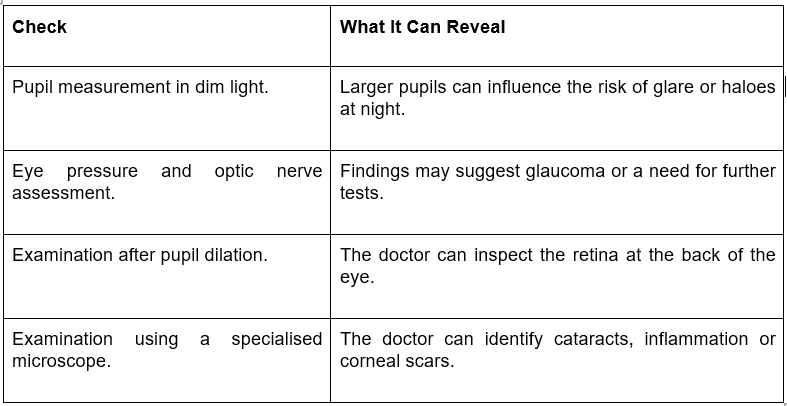
Finding another problem may mean treating it first or discussing a different approach. Each eye needs its own assessment and individual treatment plan.
How Should You Prepare for Testing?
Accurate measurements need preparation. Before your appointment:
● Ask when to stop wearing contact lenses, because they can temporarily alter corneal shape.
● Share details of medicines, diabetes, previous eye operations and any eye infections.
● Tell your doctor if you are pregnant or breastfeeding, as hormonal changes can affect your prescription.
● Mention frequent night driving and any contact sports you play.
Follow the clinic's instructions about travel after dilating drops, which can temporarily blur vision.
What Should You Take Away From the Results?
Your report should lead to a clear discussion about benefits, risks and alternatives. Laser Vision Correction includes different procedures, and being unsuitable for LASIK does not automatically mean another operation is safe.
Ask which finding supports the recommendation and whether waiting would change anything. Even suitable candidates can experience dryness, glare or residual spectacle power. LASIK also does not prevent the age-related need for reading glasses. Choose surgery only after understanding what it can realistically achieve for you.
Author

DocIndia Editorial Team
Check cache DocIndia Editorial Team works with Doctors to create informative articles.
View profile