How Ageing Impacts the Spine: Understanding Degenerative Disc Changes
On this page
- What Happens to the Spine as We Age?
- What Are Degenerative Disc Changes?
- Common Symptoms of Age-Related Spinal Degeneration
- Risk Factors Beyond Age
- How Is Degenerative Disc Disease Diagnosed?
- Treatment Options for Age-Related Degenerative Changes
- Lifestyle Changes and Physical Therapy
- Medicines and Other Non-Surgical Treatments
- Surgery
- Can Age-Related Spine Changes Be Prevented?
- When Should You Consult a Spine Specialist?
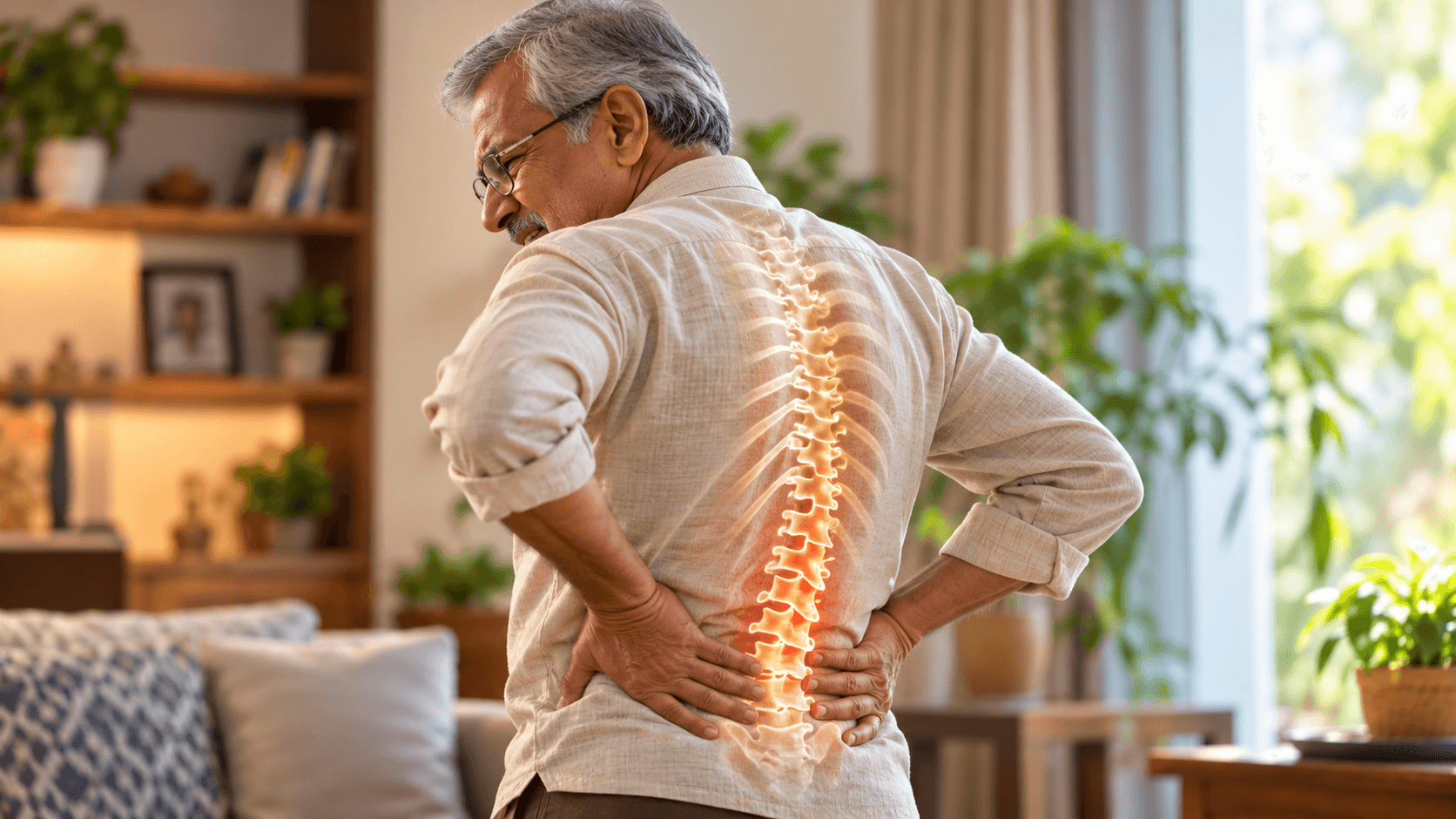
Ageing affects almost every part of the body. All vital organs, including the spine, begin to lose some function as you age. Over time, the intervertebral discs that cushion the vertebrae naturally lose some water. Due to this reason, the discs become less flexible and gradually wear down leading to disc dehydration and disc degeneration. However, these changes are a normal part of aging and do not necessarily mean that a person will develop pain or disability. In fact, many people experience gradual age-related changes in the spinal discs, joints, bones, and surrounding tissues without experiencing any symptoms.
Understanding how the spine changes with age, just like your skin develops fine lines or your joints feel a little stiffer, can help people recognise early warning symptoms, which may appear mild in the beginning. Being aware of these changes can encourage people to adopt small daily habits that support spinal health and promote spinal mobility as they age. It is also important to seek appropriate medical care when needed.
What Happens to the Spine as We Age?
The spine is an important structure consisting of vertebrae (bones), discs, joints, soft tissues, nerves and the spinal cord. The intervertebral discs are important for the normal functioning of the spine and act as cushions made of fibrocartilage, absorbing forces and allowing the spine to bend, twist and move comfortably.
With ageing, the discs gradually lose water from their soft inner core and become less flexible. Additionally, the discs become thinner, provide less shock absorption than they used to, and may develop small tears or bulges. As disc height decreases, greater stress can be placed on the small facet joints at the back of the spine. These changes can make the joint complex less capable of bearing loads, and contribute to its weakening. The body may also form bone spurs around affected areas, which are a common result of aging. These degenerative changes can contribute to conditions such as osteoarthritis of the spine, spinal stenosis, herniated discs and, in some people, degenerative spondylolisthesis.
What Are Degenerative Disc Changes?
Degenerative disc changes refer to a situation where the cushioning in your spine begins to wear away. After the age of 40, many people experience some degree of disc degeneration. However, disc degeneration itself is not necessarily a disease, but a natural part of ageing in which the discs undergo some degree of wear and tear over time.
As the intervertebral discs lose their ability to retain water, and maintain their height, they may become stiffer and less effective as shock absorbers. This may lead to a decrease in the space between adjacent vertebrae. In some cases, the surrounding structures may also undergo changes. For example, bone spurs - small bony projections that develop along the edges of joints or vertebrae - may form in response to age-related degeneration, inflammation, injury or mechanical stress. They may also develop as the body attempts to redistribute weight over a larger area. Bone spurs are commonly found in areas such as the neck, shoulders and knees. As these changes progress, the openings through which the spinal nerves travel may become narrower.
Importantly, the presence of degeneration on an X-ray or MRI does not automatically mean that a joint or spine is rapidly deteriorating, nor does it prove that degeneration is the cause of pain. Imaging findings need to be interpreted alongside the patient’s symptoms and physical examination.
Common Symptoms of Age-Related Spinal Degeneration
The condition does not always cause symptoms. While some people may have no symptoms, spinal degeneration can become symptomatic in others. Possible symptoms include:
● Persistent or recurring neck pain and back pain
● Stiffness in the back or neck that does not fully go away
● Pain that radiates down the lower back and buttocks and becomes worse with certain movements, such as sitting, bending or lifting
● Reduced range of motion as the discs dry out and lose flexibility
● Pain that travels into the legs, shoulders or arms when a nerve is compressed
● Tingling, numbness, or weakness in the arms or legs (accompanied with pain sometimes)
● Difficulty standing or walking for prolonged periods in people with spinal stenosis
● Difficulty bending forward, or lifting heavy objects
Symptoms can vary considerably depending on which part of the spine is affected, such as the lower back (lumbar spine) or neck (cervical spine) and whether nearby nerves are compressed.
Risk Factors Beyond Age
Although age is an important risk factor, and degenerative disk disease is most common in people aged 40 and older, other significant factors can contribute to the development of disc degeneration and cumulatively increase the risk for symptoms. These include:
● Smoking, which can significantly harm spinal health by reducing blood flow and decreasing bone density. It has been associated with accelerated disc degeneration
● Previous spinal injuries
● Repetitive physical activities involving bending, twisting, or lifting that place stress on the spine
● Excessive body weight, which can contribute to various spinal disorders, including degenerative disc disease, by increasing mechanical stress on the lower back
● Lack of regular exercise
● Weak or poorly coordinated core muscles, which may provide inadequate support for the spine, causing it to absorb more stress than it should
● Genetic factors or a family history of certain spinal problems
However, not all people with these risk factors will develop symptomatic degeneration. Maintaining healthy lifestyle habits and regular physical activity may help support spinal health.
How Is Degenerative Disc Disease Diagnosed?
Diagnosis generally begins with a detailed medical history and physical examination. A spine surgeon in Delhi may assess spinal movement, muscle strength, nerve function, reflexes, sensation, balance, and walking pattern. They may also assess muscle weakness or shrinking, particularly when nerve involvement is suspected. After a thorough evaluation, he may suggest you undergo imaging scans to help diagnose degenerative disc disease.
While X-rays can detect narrowing of the space between vertebrae where the disc has lost height, bone spurs, facet joint overgrowth, arthritis and changes in spinal alignment, MRI scans can create detailed images of soft tissues, making them particularly suited to visualising discs, nerves, and the spinal cord. An MRI scan can also show whether a disc has herniated (moved) and is pressing on nerve roots. On the other hand, CT scans can provide two- and three-dimensional images of the spine from a variety of angles and are particularly useful for visualising the spinal bones and bony abnormalities such as bone spurs.
The choice of imaging technique is determined by the individual’s physical symptoms. Abnormal results from an imaging study do not necessarily mean that the spinal abnormality is causing the pain.
Treatment Options for Age-Related Degenerative Changes
Treatment depends on the specific condition and severity of degeneration, symptoms, nerve involvement and overall health. While many people can manage their symptoms with non-surgical treatments, some patients may need surgical intervention to treat degenerative spine disease.
Lifestyle Changes and Physical Therapy
Maintaining regular physical activity and engaging in low-impact activities such as walking or swimming can strengthen the muscles that support the spine, relieve some pain, and help preserve mobility. A physiotherapist may recommend exercises such as hamstring stretches, cat stretch, back extension, knee to chest stretch, bird dog stretch etc. to manage the discomfort often associated with degenerative disc disease. These exercises mostly target the lower back, hip, and upper leg, and are designed to improve strength, flexibility, posture and movement patterns. Prolonged bed rest is generally not recommended for degenerative disc disease as remaining inactive for long periods can make the spine stiff.
Medicines and Other Non-Surgical Treatments
Depending on the individual's condition, a spine doctor in Delhi may recommend medications to relieve low back pain and inflammation associated with degenerative disc disease. In selected cases, corticosteroid injections may be given into the joints of the spine to reduce inflammation and relieve severe pain. Nerve block injections may also be used to target specific nerves and help relieve pain that radiates into the arms or legs. Stronger prescription medications, such as oral steroids and muscle relaxants, may sometimes be prescribed for short-term relief when muscle spasms accompany spinal pain. However, there isn't a one-size-fits-all approach to medication. The type, dosage, and duration of medication should be determined by a spine surgeon in Delhi based on the individual's clinical symptoms, medical history, other medications they may be taking and additional factors influencing how they may process the drug.
Surgery
The presence of degenerative changes on an imaging scan does not necessarily mean that surgery is required. It may be considered when there is persistent pain and/or weakness, significant nerve or spinal cord compression, or when appropriate non-surgical treatments such as physical therapy and medicines have failed to provide adequate relief.
Depending on the underlying symptoms and diagnostic findings, procedures may include decompression surgery, discectomy, spinal fusion, or, in selected patients, artificial disc replacement. The appropriate procedure depends on the levels involved, the specific anatomy of the patient, the diagnosis, and the underlying cause of the pain.
Can Age-Related Spine Changes Be Prevented?
Ageing itself cannot be stopped, but several habits may help support spinal health:
● Stay physically active and take regular movement breaks in between work or other tasks instead of remaining seated for long periods.
● Maintain a healthy body weight and good muscle strength
● Maintain a healthy diet and get the recommended daily intake of calcium and vitamin D, two key components needed for healthy, strong bones.
● Avoid smoking as it is linked to low back pain and increased discomfort
● Use proper techniques when lifting heavy objects.
● Follow an exercise program appropriate for your age and physical condition. Exercises such as curl-ups, side planks, and bird-dog exercises can engage important muscles that help improve spine stability.
● Address persistent back or neck symptoms and their underlying cause rather than focusing solely on suppressing the symptoms.
These lifestyle changes cannot guarantee that degenerative changes will not occur, as some degree of spinal degeneration is a normal part of ageing.
When Should You Consult a Spine Specialist?
Occasional or sudden pain and discomfort in the back and neck area does not necessarily indicate serious spinal disease. However, medical evaluation is advisable when pain persists, or repeatedly returns after providing temporary relief. Medical evaluation is also recommended when pain and other symptoms are so intense that they interfere with daily activities, are accompanied by symptoms such as numbness, tingling, or weakness, or when there is significant nerve or spinal cord compression or structural instability.
A consultation with a spine specialist doctor in delhi can help determine whether your symptoms are caused by disc degeneration, age-related wear and tear, or another spinal condition. The doctor can also assess whether further tests or treatment are needed.
Certain symptoms require prompt medical attention. These include back pain accompanied by fever, unexplained weight loss, new bladder or bowel problems, significant or progressive weakness, or severe numbness, and should be evaluated urgently.
Author

DocIndia Editorial Team
Check cache DocIndia Editorial Team works with Doctors to create informative articles.
View profile