Work Visa for Doctors Abroad: Complete Guide to Employment Routes and Golden Visas (2026)
On this page
- Why Indian Doctors Are Moving Abroad: The Real Drivers
- Primary Employment Routes by Destination
- United States: J-1, H-1B, and the Green Card Path
- United Kingdom: NHS Sponsorship and the Health & Care Visa
- Canada: The New Physician-Specific Express Entry
- UAE: Employer Visas and the Doctor's Golden Residency
- Germany, Australia, Singapore, and New Zealand
- Golden Visas and Investment Residency: The Other Half of the Strategy
- Portugal: The D7 Route for Doctors with Remote Income
- Greece: The EU Golden Visa That Still Works
- Caribbean CBI: The Mobility Play
- Pathways Compared: A Quick Reference
- What Dual Residency Actually Looks Like in Practice
- Final Thoughts

Foreign-trained doctors now make up roughly 20% of the physician workforce across OECD countries — up from 16% just fifteen years ago. That number tells a clear story about where global medicine is heading.
And Indian doctors are right at the center of it. About 75,000 Indian-trained physicians are currently working in OECD countries, with nearly two-thirds of them in the United States and around 19,000 in the UK alone.
But here's what's changed in 2026: smart physicians aren't just following the traditional work-visa-then-residency path anymore. They're layering employment routes with investment-based residence programs to build careers that don't depend on a single employer, a single country, or a single visa category.
This guide covers both sides of that equation — the major employment-based routes by destination, and the golden visa options that give doctors genuine flexibility and long-term security.
Why Indian Doctors Are Moving Abroad: The Real Drivers
The motivations go well beyond salary, though that certainly matters. A specialist working in the US or UAE earns multiples of what the same role would pay in India, with more predictable reimbursement models and far less administrative friction.
Beyond earnings, the pull includes subspecialty training that simply doesn't exist at scale in India, structured residency programs, research exposure, and international fellowships. Add to that the lifestyle considerations — stable political environments, personal safety, quality schooling for children — and the picture becomes quite complete.
And then there's the mobility angle. Holding a stronger passport or an EU residence permit fundamentally changes what a physician can do professionally: attend conferences without scrambling for visas, pursue locum roles across borders, and build consulting income streams in multiple jurisdictions.
Primary Employment Routes by Destination
United States: J-1, H-1B, and the Green Card Path
The US remains the top destination for Indian medical graduates, but it's also the most demanding pathway in terms of time and complexity.
Most physicians enter residency on a J-1 Exchange Visitor visa , which comes with a two-year home-country residence requirement at the end of training. That requirement can be waived through service in a medically underserved area — the Conrad 30 program — or through hardship-based waivers. The H-1B route avoids that two-year rule but is subject to annual numerical caps, though cap-exempt employers like universities and nonprofits offer a cleaner path.
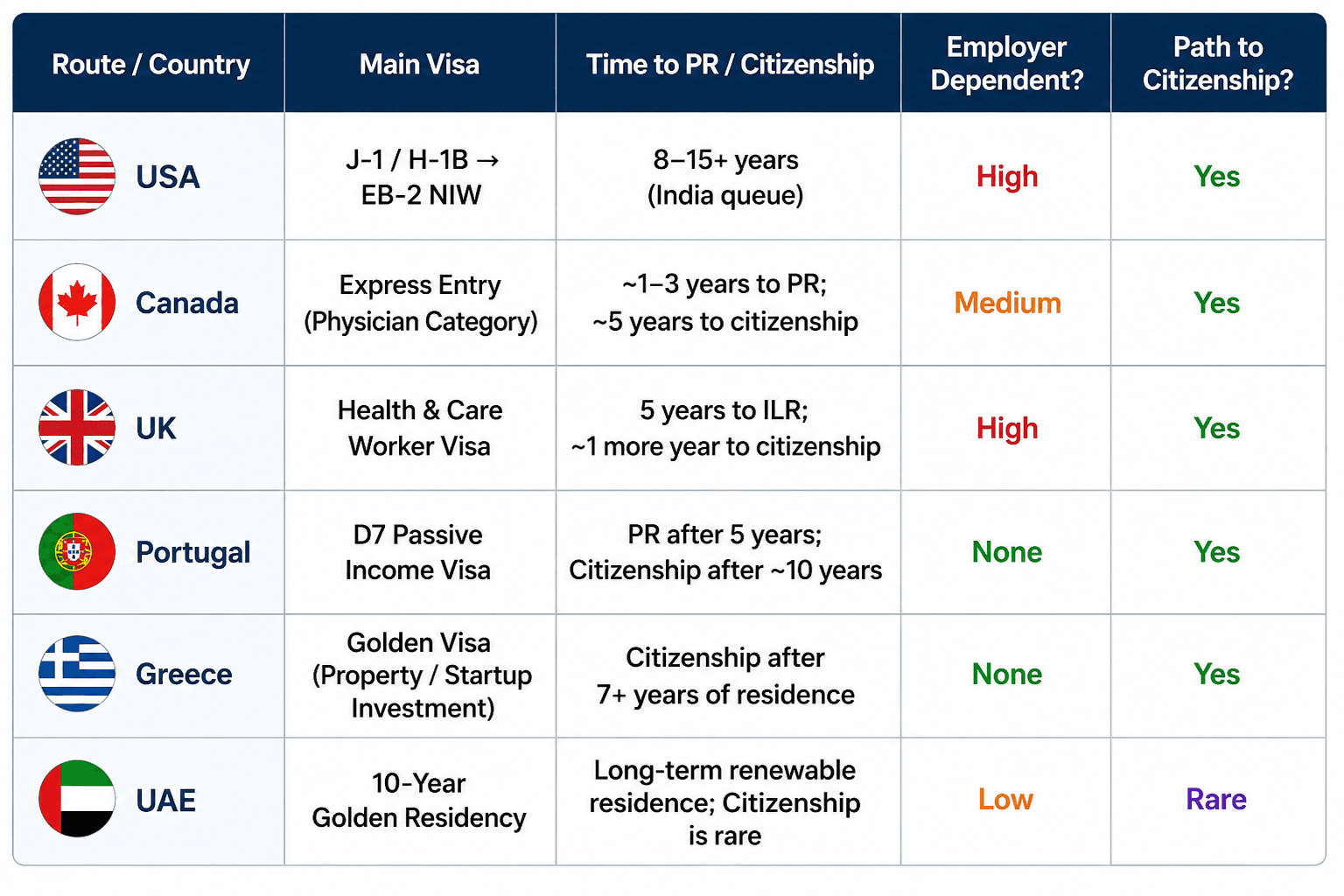
For permanent residency, the EB-2 NIW (National Interest Waiver) for physicians is the most direct route. It requires working in a designated shortage area for a set number of years in exchange for a green card without needing employer sponsorship. The catch for Indian nationals: backlogs can stretch to many years depending on the priority date queue.
Realistic timeline from USMLE prep to US citizenship: often 12–18 years, accounting for exams, residency, waiver service, green card processing, and naturalization. It's a marathon, not a sprint.
United Kingdom: NHS Sponsorship and the Health & Care Visa
The UK pathway is considerably faster in terms of getting to work, if not to citizenship. Indian doctors typically pursue GMC registration via PLAB or through recognized postgraduate qualifications, combined with IELTS or OET for English proficiency.
Once registered, the Health and Care Worker visa — a subcategory of the Skilled Worker route — requires a confirmed job offer, Certificate of Sponsorship from an NHS or CQC-registered employer, and a minimum salary threshold (now £31,300 for many roles as of April 2026). Visa processing runs about 3–8 weeks once sponsorship is in place.
After five years on the Health and Care visa, indefinite leave to remain becomes available, followed by citizenship eligibility roughly one year later. Total timeline to British citizenship for an Indian doctor starting from PLAB: typically 7–10 years.
Canada: The New Physician-Specific Express Entry
Canada made a significant move in late 2025 by introducing a dedicated Express Entry category for physicians with Canadian work experience. The first physician-specific draw in early 2026 issued 391 invitations with a CRS cutoff of 169 — competitive, but a clear signal that Canada is actively prioritizing medical professionals.
To qualify, doctors need at least one year of full-time Canadian physician work in the last three years and eligibility under an existing Express Entry program. An additional 5,000 provincial nominee spots were also announced specifically for international doctors, widening the options further.
Once PR is secured, citizenship eligibility arrives after three years of physical presence. That makes Canada's timeline — typically 3–6 years from arrival to citizenship — considerably shorter than the US equivalent for Indian-born physicians.
UAE: Employer Visas and the Doctor's Golden Residency
The Gulf remains one of the highest-paying destinations for physicians, with strong demand across internal medicine, anesthesiology, ICU, pediatrics, obstetrics, and surgical subspecialties in both public and private systems.
Standard entry is via an employer-sponsored work visa through major hospital groups or government health systems in Dubai, Abu Dhabi, or Sharjah, with licensing through DHA, DOH, or MOH depending on the emirate.
But the UAE also offers something distinct: a 10-year renewable Golden Residency for doctors under the "talented individuals and exceptional specializations" category. Qualifying physicians need an approval letter from the Ministry of Health, and in return they receive long-term residence independent of any employer sponsor. That's a meaningful shift from the traditional employment-tied visa model — and it's genuinely useful for senior consultants who want UAE presence without being locked to a single hospital group.
Germany, Australia, Singapore, and New Zealand
Germany's EU Blue Card route works well for physicians who meet salary thresholds and can navigate the state-level qualification recognition process. The main barrier is language — B2 to C1 German is typically required for full licensure, plus knowledge exams for foreign graduates. High-demand specialties include internal medicine, geriatrics, anesthesiology, and rural GP roles.
Australia operates through the AMC exam pathway or the Competent Authority route for doctors with UK or US credentials, feeding into skilled migration visas and eventually PR. New Zealand follows a similar model, with the Medical Council of NZ assessing foreign qualifications and shortages in rural GP, psychiatry, and emergency medicine making sponsorship relatively accessible.
Singapore's Employment Pass requires SMC registration and a salary meeting current EP minimums — competitive, but the market is smaller and more selective than Gulf or Anglophone countries.
Golden Visas and Investment Residency: The Other Half of the Strategy
Here's where the calculus gets interesting. Employment visas tie residence to a job. Golden visas don't.
For a physician working in Canada who wants an EU base for their family, or a consultant radiologist running a teleradiology practice from India who wants a path to European citizenship, investment-based residency programs offer something that no employment visa can: residence that persists regardless of where the income comes from.
Portugal: The D7 Route for Doctors with Remote Income
Portugal's D7 passive income visa is genuinely well-suited to physicians with stable foreign earnings — teleradiology income, teleconsulting fees, or practice ownership abroad. The 2026 requirement is passive income of at least €920 per month and health insurance with at least €30,000 coverage.
Processing runs 4–12 weeks at the consulate level, followed by a two-year renewable residence card. Permanent residency becomes available after five years; citizenship after ten years of legal residence, subject to Portuguese language requirements.
Portugal's reformed golden visa — now focused on investment funds, R&D, and cultural projects rather than real estate — remains an option for higher-net-worth physicians. Specialists considering this route, according to Global Residence Index , a firm that works specifically with EU residence and citizenship by investment programs, should evaluate fund-based options carefully against their risk profile and long-term objectives, particularly if they're already earning from EU or Middle East contracts.
Greece: The EU Golden Visa That Still Works
Greece's golden visa grants a five-year renewable residence permit via real estate investment (traditionally from €250,000) or, as of 2026, via equity in an Elevate Greece-registered startup with the same minimum investment threshold and job creation obligations.
Greek citizenship becomes available after seven years of continuous legal residence, subject to language and integration tests. For a physician building an international career, a Greek golden visa provides Schengen access and an EU base while clinical work and income remain elsewhere — a genuinely clean separation between where you live, where you work, and where your passport is from.
Caribbean CBI: The Mobility Play
Caribbean citizenship-by-investment programs from St. Lucia, Antigua & Barbuda, St. Kitts & Nevis, and others grant citizenship — not just residency — through qualifying contributions or investments. For Indian doctors with an Indian passport, these second citizenships can meaningfully reduce visa friction for international conference travel, multi-country locum work, and cross-border consulting.
The landscape is evolving: EU and UK restrictions on some Caribbean programs' visa-free access have tightened in recent years, so the value proposition depends heavily on which specific passport is involved and what travel rights it currently carries.
Pathways Compared: A Quick Reference
What Dual Residency Actually Looks Like in Practice
Consider a composite scenario that's increasingly common: an Indian radiologist who built a teleradiology group providing remote reporting services to hospitals in Europe and the Middle East. With stable monthly income well above Portugal's D7 threshold, they apply for Portuguese residence — getting an EU base, access to Portugal's healthcare system, and a decade-long path to citizenship — without ever needing a local employer.
Or take an NHS consultant who reached ILR in the UK and wants a backup EU base for their family post-Brexit. A Greek golden visa investment provides Schengen zone residence with minimal physical presence requirements, giving the family European mobility while the physician continues working in the UK.
These strategies aren't complicated in concept, but they have real tax implications — dual residency creates competing claims on income, and India's non-recognition of dual citizenship adds another layer of planning. Double tax treaty provisions between India and the destination country, FATCA obligations for US-connected physicians, and the Foreign Earned Income Exclusion for US taxpayers working abroad all need to be factored in alongside the visa strategy.
Final Thoughts
The traditional model — pick a country, pass the exams, work for a sponsor, wait for residency — still works. It's just no longer the only model, and for many Indian physicians it's no longer the optimal one.
The doctors building the most resilient international careers in 2026 are the ones combining employment-based routes with investment residency in a second jurisdiction: a working visa where the income is highest, and a golden visa where the lifestyle, mobility, or tax position makes sense independently.
Getting that combination right requires current, country-specific advice. Programs change — Spain's property golden visa closed entirely in 2025, Portugal reformed its real estate route, and Malta restructured its citizenship offering after an EU court ruling. What worked two years ago may not be the right answer today.
Author

DocIndia Editorial Team
Check cache DocIndia Editorial Team works with Doctors to create informative articles.
View profile