Understanding the Vagus Nerve: Can Sound Vibrations Help You Relax?
On this page
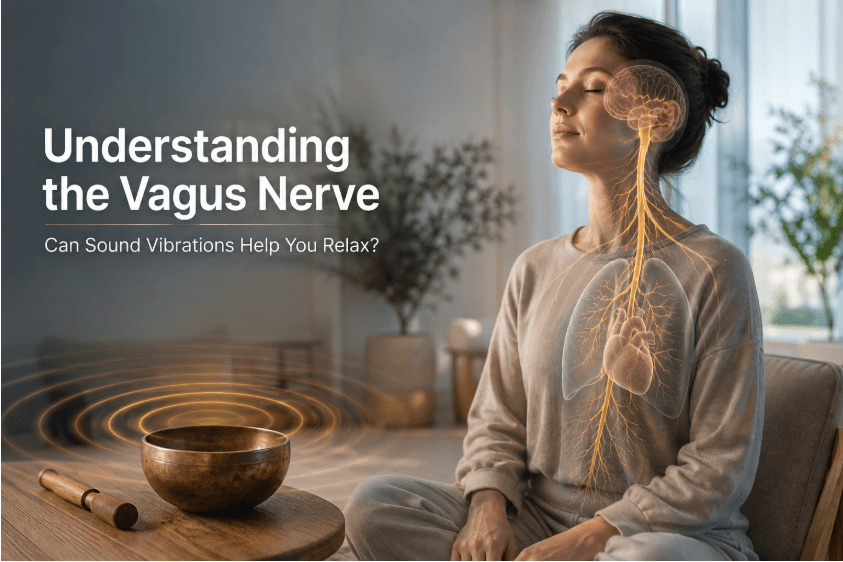
Most people who feel "wired but tired" are not short on willpower. They are living in a nervous system that has forgotten how to downshift. You finish work, close the laptop, and your body still behaves as though something urgent is about to happen — shallow breathing, tight shoulders, a mind that keeps scanning.
At the centre of that switch between alertness and calm sits the vagus nerve. It has become a popular topic in wellness circles, and with that popularity has come a fair amount of exaggeration. This article takes a calmer view: what the vagus nerve actually does, why sound and vibration are increasingly used in relaxation practice, and how tools such as handmade Nepal singing bowls fit into a grounded, realistic routine.
What the Vagus Nerve Actually Is
The vagus nerve is the longest of the cranial nerves. Its name comes from the Latin word for "wandering," which describes its path well — it travels from the brainstem down through the neck and chest and into the abdomen, connecting to the heart, lungs, and digestive organs along the way.
It is the main highway of the parasympathetic nervous system, often summarised as the "rest and digest" state, in contrast to the sympathetic "fight or flight" response.
A few points worth understanding:
It is mostly a listener: Roughly 80% of vagal fibres carry information upward, from the body to the brain. Your brain is constantly reading signals from your organs to decide how safe you are.
It influences rhythm, not just mood: Vagal activity affects heart rate, breathing patterns, and digestive movement.
It responds to physical cues: Slow exhalation, humming, gentle movement, warmth, and steady rhythmic sound are all inputs the nervous system registers.
That last point is the practical bridge to sound-based practices. You cannot instruct yourself to relax and expect compliance. You can, however, give the body signals that it interprets as safety.
Why Sound and Vibration Enter the Conversation
Sound is unusual among relaxation tools because it works on two levels at once: it is heard, and it is felt.
A sustained tone gives attention something simple and continuous to rest on. Compared with silent meditation, which many beginners find difficult, a tone provides an anchor that is easy to return to. When the mind wanders, the sound is still there.
There is also the physical dimension. Low, resonant tones produce vibration that can be perceived in the chest, throat, and abdomen — regions richly served by vagal pathways. This is part of why humming, chanting, and toning have appeared independently in traditions across the world for centuries. Even something as ordinary as extending an exhale into a low hum lengthens the out-breath, which is commonly associated with relaxation. Researchers continue to study how these practices influence the nervous system, and the exact mechanisms are not yet fully understood.
Research into sound-based relaxation is still developing rather than settled. Some studies have reported improvements in self-reported stress, mood, and relaxation, but the evidence remains limited and does not establish that sound vibrations directly stimulate the vagus nerve. For a balanced overview of current findings, including both the potential benefits and the limitations of existing research, see this guide on the science of singing bowls and what research actually shows .
A note on expectations: sound practices are a supportive wellness tool, not a medical intervention or a replacement for professional care.
What Distinguishes Handmade Singing Bowls
Metal singing bowls are the most common instrument used for this kind of practice, and the difference between a mass-produced bowl and a hand-hammered one is immediately audible.
Machine-pressed bowls are formed uniformly. They tend to produce a single, clean, somewhat sterile tone that fades quickly. Hand-hammered bowls are worked over hours by artisans, and the small irregularities in thickness and shape create multiple overtones layered within one strike. The result is a tone with movement in it — a sound that continues to unfold rather than simply stopping.
This is why traditional handmade singing bowls from Kathmandu remain the reference standard for practitioners. The Kathmandu Valley has an unbroken metalworking lineage, and workshops there continue to produce bowls using alloy compositions and hammering methods passed down through families.
When evaluating a bowl, pay attention to:
- Sustain — how long the tone holds after a single strike
- Overtone complexity — whether you hear one note or several woven together
- Tactile vibration — whether you can feel the resonance through the rim or the palm
- Visible hammer marks — an honest indicator of hand-forging
- Alloy quality — traditional bronze alloys ring differently from thin, cheap metal
If you are comparing options, it is worth listening to recordings of healing singing bowls at different sizes before buying. Larger bowls generally produce lower, more physically felt tones; smaller bowls produce brighter, more focused ones.
Building a Practice That You Will Actually Keep
The most common mistake is treating sound work as an occasional event. Nervous system regulation responds to repetition, not intensity.
A simple ten-minute structure:
1. Settle (1 minute): Sit comfortably. Let the exhale become slightly longer than the inhale. No forcing.
2. Strike and listen (4 minutes): Strike the bowl once with a padded mallet. Follow the tone all the way to silence before striking again. The listening is the practice.
3. Feel, don't analyse (3 minutes): Rest the bowl on your palm or near your body and notice where vibration registers. Curiosity, not effort.
4. Close (2 minutes): Sit in silence. The quiet after the tone is often where the shift becomes noticeable.
Practical guidance:
- Consistency beats duration. Ten minutes daily outperforms an hour once a month.
- Evening sessions suit people whose main difficulty is winding down.
- Volume should be moderate. Loud is not more effective.
- Do not chase dramatic sensations. Subtle is normal and sufficient.
Where Sound Work Fits Alongside Other Habits
Sound practice works best as one element in a broader routine rather than a standalone solution. It tends to pair naturally with:
- Slow breathing, particularly extended exhalation
- Gentle yoga or restorative stretching
- Reduced screen exposure in the hour before sleep
- Consistent sleep and wake times
- Mindful attention during ordinary daily tasks
Yoga teachers frequently place bowl work at the close of a session, when the body has already softened and attention is more available. Therapists and bodyworkers use it similarly, as a transition into stillness.
Summary
The vagus nerve is not a switch you can flip on command. Practices such as slow breathing, quiet attention, and steady resonant sound may help create a more relaxed state, but evidence that sound vibrations directly stimulate the vagus nerve remains limited.
Sound-based relaxation is worth approaching with realistic expectations: it is a practice, not a cure, and its value accumulates through repetition. Instrument quality genuinely matters here, which is why hand-forged Nepalese bowls continue to be preferred over mass-produced alternatives — richer overtones and longer sustain simply give attention more to rest on.
Author

DocIndia Editorial Team
Check cache DocIndia Editorial Team works with Doctors to create informative articles.
View profile