Laser Pimple Scar Removal: How Dermatologists Choose Between Laser and Non-Laser Treatments
On this page
- Why Acne Scars Are Not All the Same
- Atrophic Acne Scars: Types and Treatment Choices
- Raised Acne Scars: Hypertrophic and Keloid
- Laser vs Non-Laser: How Dermatologists Decide
- Where Laser Pimple Scar Removal Fits
- Where Non-Laser Treatments Fit
- Scars After Forehead Pimples
- What Dermatologists Want You to Know
- Questions to Ask Before Starting Treatment
- Conclusion
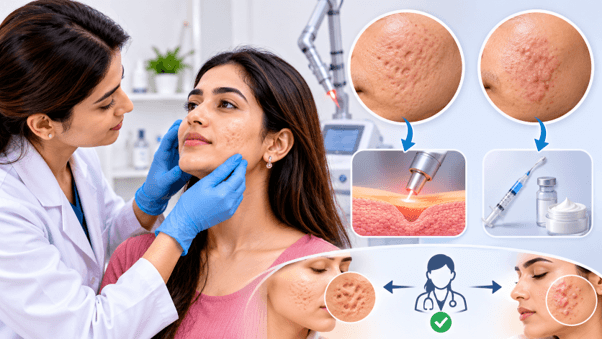
You cleared the pimples, but the marks stayed behind. Every photo, mirror, and bright light seems to find them.
Acne is common. Clinical studies show it affects up to 80% of people between the ages of 11 and 30. The marks it leaves can hurt confidence long after the breakout ends.
Many people search for laser pimple scar removal and assume it works for every scar. It does not. The right treatment depends on the scar type, and modern dermatology starts with that question.
Why Acne Scars Are Not All the Same
Acne scars form when skin heals after deep inflammation. The body either loses tissue or builds too much of it. This gives two broad groups: atrophic scars and raised scars.
● Atrophic scars are dents or depressions. They form when collagen, the protein that keeps skin firm, is lost during healing.
● Raised scars are firm bumps that sit above the skin. They form when the body makes too much collagen.
Treating both with the same method can disappoint you. This is why a dermatologist examines the scar before suggesting any procedure.
Atrophic Acne Scars: Types and Treatment Choices
Atrophic scars are the most common type. Dermatologists usually sort them into three patterns.
Icepick Scars
These are narrow, deep, and pointed. They look like small holes. They often need targeted methods such as TCA CROSS (a focused chemical technique) or punch excision.
Boxcar Scars
These are wider, with sharp, defined edges. They look like shallow craters. Fractional laser resurfacing or microneedling often suits them.
Rolling Scars
These have a wavy, uneven look. They form when fibrous bands pull the skin downward from below. Subcision, which releases those bands, is often combined with other treatments.
Raised Acne Scars: Hypertrophic and Keloid
Hypertrophic scars rise above the skin but stay within the original pimple area. Keloid scars grow beyond it. Both are more common on the chest, back, and jawline.
Treatment is different from that for atrophic scars. Options include silicone-based therapy, steroid injections, and pulsed dye laser (a laser that targets redness and blood vessels). Aggressive resurfacing can sometimes worsen raised scars, so careful selection matters.
Laser vs Non-Laser: How Dermatologists Decide
There is no single best option. Dermatologists weigh several factors before choosing.
● Scar type and depth : Shallow and deep scars need different tools.
● Skin tone : Darker Indian skin tones carry a higher risk of post-inflammatory hyperpigmentation, which is darkening after skin injury. Settings and laser type must be chosen carefully.
● Active acne : Ongoing breakouts are usually controlled first.
● Downtime : Some treatments need several days of recovery. Others allow a quicker return to routine.
● Budget and goals : Most scars need a combination plan over several sessions.
Where Laser Pimple Scar Removal Fits
Laser pimple scar removal uses focused light energy to treat the skin. The type of laser determines which concern it targets. At Kosmoderma, two advanced options are used: PICO laser and Q-switch laser.
PICO Laser
PICO is a picosecond laser. It delivers energy in extremely short pulses, measured in trillionths of a second. These pulses break up pigment and trigger the skin’s natural repair response, including new collagen production.
PICO is often considered for post-acne marks and mild textural irregularities. Its short pulses also mean less heat reaches the surrounding skin. This may help with comfort and recovery.
Q-Switch Laser
A Q-switch is a nanosecond laser. It releases high-energy pulses that shatter excess pigment into tiny particles. The body then clears these particles naturally.
This makes Q-switch a common choice for dark marks left after pimples. Dermatologists call this post-inflammatory hyperpigmentation. It is most useful when discoloration, not a dent, is the main concern.
Which One Suits You?
1. Dark or uneven acne marks: Both lasers target pigment. Your dermatologist picks the one that fits your skin.
2. Mild surface texture: PICO is often considered for this concern.
3. Deeper dents: These may need additional methods, such as subcision or microneedling, alongside laser.
Both treatments usually need a series of sessions. Visible improvement depends on your skin type, scar depth, and aftercare. A dermatologist will assess your scars before recommending a plan.
Where Non-Laser Treatments Fit
Non-laser options are not "lesser" options. For some scars, they are the better choice.
● Microneedling: Fine needles trigger collagen production. It is often used for mild to moderate atrophic scars.
● Subcision: A fine needle releases tethered scar bands under the skin.
● TCA CROSS: A small amount of concentrated acid is placed inside icepick scars.
● Dermal fillers: These can lift selected depressed scars for a temporary period.
● Chemical peels: These improve surface texture and uneven tone.
Dermatologists often combine laser and non-laser methods in one plan. A rolling scar, for example, may need subcision first and laser later.
Scars After Forehead Pimples
The forehead has many oil glands, and it is exposed to sweat, helmets, and hair products. This makes breakouts common there. Early forehead pimples treatment matters because picking or delaying care raises the risk of scarring.
If a forehead scar has already formed, the same scar-type rule applies. Shallow marks may respond to peels or microneedling. Deeper dents may need laser or a combination approach.
What Dermatologists Want You to Know
"[DRAFT QUOTE, NEEDS DOCTOR APPROVAL: Acne scars need to be matched to the right treatment. A scar type that responds well to laser may need a different approach if the skin is prone to pigmentation," says Dr. [Name], [Designation], Kosmoderma Skin, Hair, Body Clinics.
Questions to Ask Before Starting Treatment
● What type of acne scars do I have?
● Is laser suitable for my skin tone?
● How many sessions will I likely need?
● What recovery and aftercare should I plan for?
● Should any active acne be treated first?
Conclusion
Acne scars are common, and wanting to treat them is completely valid. You do not have to live with frustration or guess at solutions. Once you know the scar type, the treatment path becomes clearer and more realistic.
Achieving healthier-looking skin is a journey that goes beyond the surface. If you are unsure whether laser pimple scar removal or a non-laser approach suits you, consulting a qualified dermatologist can save you time, money, and frustration. You can also read about [advanced acne scar revision treatments to learn more.
Author

DocIndia Editorial Team
Check cache DocIndia Editorial Team works with Doctors to create informative articles.
View profile