How a Second Opinion Can Help You Choose the Best Cancer Treatment
On this page
- When should you obtain a second opinion?
- Why is it important to obtain a second opinion?
- Confirming the Diagnosis
- Ensuring Correct Staging
- Accessing Additional Treatment Options
- Benefits of Consulting a Second Opinion Specialist for Cancer Treatment
- Does a Delay in Getting a Second Opinion Impact Timing of Receiving a Cancer Diagnosis?
- The Role of Teleconsultation in Cancer Care
- What do You Need to Bring to Your Teleconsultation?
- Why Many People Seek a Second Opinion in India?
- In Conclusion

When faced with being told they have cancer, patients are overwhelmed by various questions and concerns. Patients and their families must decide which treatments to pursue (surgery, chemotherapy/radiation/targeted therapy/immunotherapy, or clinical trials) with guidance from multiple sources in a very short amount of time.
All recommendations made by your treating physicians are based on what is best for the patient. However, obtaining a second opinion for cancer treatment from someone who specialises in cancer may provide you with additional peace of mind or open up new avenues for your treatment.
It is now much easier to obtain a second opinion in India due to the rise of teleconsultation. Patients who want more information about their diagnosis can seek a second opinion from one of the world's leading cancer specialists without incurring the expense or inconvenience of travel.
A second opinion means you have another qualified cancer specialist independently evaluate your diagnosis, pathology report, imaging results, and recommended treatment options.
Obtaining a second opinion does not take the place of your current doctor but rather acts as an assurance of:
● The diagnosis is accurate.
● The cancer stage has been correctly identified.
● The proposed treatment follows current international guidelines.
● Alternative treatment options have been considered.
Many oncologists advise patients to seek a second opinion, since there are several approaches to managing cancer.
When should you obtain a second opinion?
Patients may request a second opinion at any point in time; however, it is particularly helpful to obtain one when:
● Newly diagnosed cancer
● Rare or uncommon cancers
● Advanced or metastatic disease
● Recurrence after previous treatment
● Recommendation for major surgery
● Multiple treatment options are available
● Lack of improvement despite treatment
● Desire to explore newer therapies or clinical trials
Even if treatment has already started, a second opinion may still help optimise future care. In addition to potentially providing more informed future care, obtaining a second opinion can help determine the current status and future care options.
Why is it important to obtain a second opinion?
Confirming the Diagnosis
Diagnosing cancer requires pathology reports, radiology images, and other laboratory results to confirm/recheck the biopsy reports (including obtaining new biopsies). Often, by reviewing your previous biopsy slides or radiological imaging, the radiologist or pathologist can refine or change the diagnosis. A correct diagnosis is critical to receiving effective cancer treatment.
Ensuring Correct Staging
The stage of cancer is a major determinant of a patient's treatment plan. Additional imaging/testing and/or an expert review can yield new information that will change how advanced the cancer is believed to be and will lead to significant changes to the proposed treatment plan.
Accessing Additional Treatment Options
Cancer treatment may be available at a variety of hospitals with differing capabilities and technologies to support the available treatment options.
Considering a second opinion may yield additional options such as:
● Robotic surgery
● Organ-preserving treatments
● Precision medicine
● Targeted therapy
● Immunotherapy
● Proton therapy
● CAR-T therapy
Knowing every available option allows patients to make informed decisions.
Benefits of Consulting a Second Opinion Specialist for Cancer Treatment
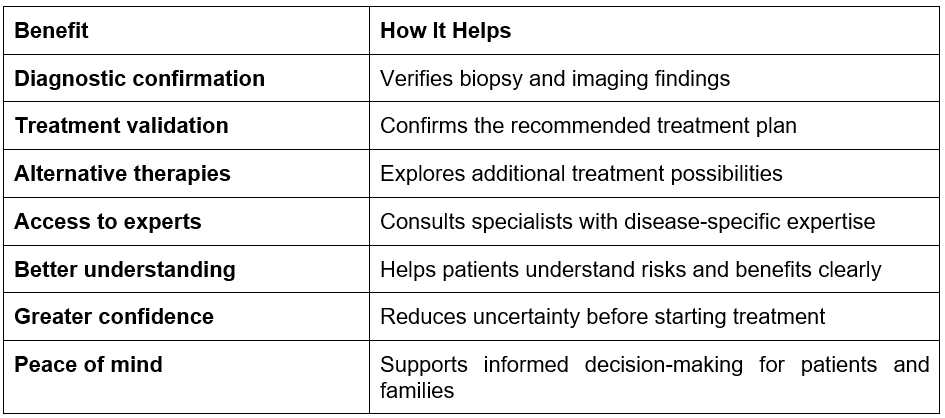
Does a Delay in Getting a Second Opinion Impact Timing of Receiving a Cancer Diagnosis?
Many people worry that getting a second opinion will waste their precious time. Most of the time, you will not lose any time when requesting a second opinion.
Many major cancer centres that provide second opinions do so quickly (usually within a few days), especially through technology-enabled teleconsultation services. Many diagnostic imaging studies and reports are available digitally; you will likely receive your specialist's results quickly while continuing the necessary testing.
The Role of Teleconsultation in Cancer Care
Teleconsultation, or the ability to communicate online with your healthcare specialists, has changed how you access cancer specialists. Through teleconsultation, you can receive the same level of expert care you would receive if you were able to visit your oncologist's office.
Some examples of patients who benefit from teleconsultations include:
● Patients living in remote areas.
● Senior citizens.
● Patients from other countries.
● Patients seeking a specialist’s advice before travelling for treatment.
● Patients’ families and caregivers who need reassurance that they will receive the most appropriate care.
During a teleconsultation with oncologist , who specialises in second opinions will review your medical history and discuss your treatment options, provide a prognosis for each, and answer all your questions thoroughly. If surgery and/or other aggressive treatment is necessary after your teleconsultation, you will have more time to schedule travel arrangements.
What do You Need to Bring to Your Teleconsultation?
To ensure your teleconsultation goes as smoothly as possible, it is critical that you have your complete medical history available at the time of the consultation.
● You should keep records of:
● Biopsy reports
● Histopathology reports
● Blood test results
● PET-CT, CT, MRI, or X-ray images
● Previous treatment records
● Surgical notes
● Current medications
● Hospital discharge summaries
● Questions you wish to discuss
Questions to Consider When Seeking a Second Opinion
By preparing questions in advance, you can make the most of your time with the second-opinion specialist.
Questions you might consider asking are:
● Is my diagnosis correct?
● Is the cancer correctly staged?
● What are the available options for treatment?
● For each option, what are the risks and benefits?
● Would there be an option for minimally invasive surgery?
● Am I eligible for either targeted therapy (e.g. hormonal therapy) or immunotherapy?
● What clinical trials are available that are appropriate for me?
● What outcomes can I expect?
● How urgent is the need for starting treatment right away?
Having clear answers to these questions will help you feel more informed and confident.
Why Many People Seek a Second Opinion in India?
India is quickly becoming the most popular destination for comprehensive cancer treatment due to its highly experienced doctors, comprehensive cancer care, and lower costs than most of the rest of the world.
Patients have contact with:
● Medical oncologists
● Surgical oncologists
● Radiation oncologists
● Cancer specialists that specialise by organ
● Laboratories with more advanced diagnostic technologies
● Oncologists that provide precision-based therapy
● Comprehensive cancer care centres providing multi-disciplinary team-based (MDT approach) treatment
Many cancer hospitals in India provide telemedicine and international patient coordinators who can assist patients in communicating with specialists worldwide.
The following questions may assist you in choosing the best second opinion provider when seeking a second opinion regarding your condition:
● Is the physician experienced with treating your specific type of cancer?
● Is the physician board-certified?
● Is the physician able to manage your medical care using a multidisciplinary approach (MDT)?
● Does the doctor have access to advanced therapies (targeted therapy/immunotherapy)?
● Will the physician communicate with you throughout your treatment?
● Are there diagnostic tests available to make an accurate diagnosis?
● Can the physician provide teleconsultation?
It is important to choose a physician who provides tailored recommendations addressing your specific circumstances, rather than relying on generic, even inappropriate, recommendations.
In Conclusion
An impending cancer diagnosis can be extremely daunting; however, you do not have to make the decisions regarding treatment options that you might face without the help of others. By acquiring a second opinion, you are taking an action to help clarify your diagnosis, confirm the treatment plan, find alternative and/or newer treatment options and most importantly to provide yourself with peace of mind.
In addition to having access to highly qualified oncologists in India, there are now many teleconsultation services available across the country that facilitate the ability for you to get this type of expert opinion. No matter if you’ve just been diagnosed, looking to determine whether you need surgery or considering high-tech therapy options, the decision to consult with an oncologist for a second opinion can provide you with confidence in your decision-making along your journey through the disease, and ensure that you have the highest quality of medical input available to you for each phase of your treatment.
Author

DocIndia Editorial Team
Check cache DocIndia Editorial Team works with Doctors to create informative articles.
View profile