5 Myths About Senior Citizen Health Insurance That Can Cost Your Family Lakhs of Rupees
On this page
- Myth 1 – “Emergency funds are enough to pay for hospital bills”
- Myth 2 – Pre-existing diseases are not covered by senior citizen health insurance
- Myth 3 – Family insurance is enough for ageing parents
- Myth 4 – Premiums are very high, and not worth the value of money
- Myth 5 – Choosing the cheapest policy will save money
- Quick Recap: Myth vs Reality about Senior Citizen Health Insurance
- Final Verdict
Imagine your 70-year-old father is hospitalized for a medical emergency. While you feel emotionally stressed, you are relieved that your health insurance will cover the treatment cost. However, at the time of claims, you get a bill worth lakh of rupees to be paid from your pocket. Such a situation is distressing as well as financially challenging. Let us bust some myths that spread misinformation regarding senior citizen health insurance.
Myth 1 – “Emergency funds are enough to pay for hospital bills”
One may think that the pool of money they are saving for an emergency can help them sail through a medical crisis even without insurance. Hence, a health insurance policy is not useful, especially for a healthy senior citizen.
However, no one can predict illnesses and accidents. Moreover, the average cost of a major surgery in India ranges from ₹2 lakh to ₹8 lakh. Some surgeries or treatments for critical illnesses, like complex cardiac conditions, cancer, organ transplants, etc., can cost even above ₹20 lakh.
Arranging such a large amount at the last minute is very difficult, especially for a senior citizen who may not have a regular source of income. This can result in exhausting the life-long savings or retirement funds in one go.
Health insurance for senior citizens covers the majority of the hospital bill, financially protecting your family and keeping your savings intact.
Myth 2 – Pre-existing diseases are not covered by senior citizen health insurance
Most people wrongly believe that a senior citizen will not be able to get health insurance if they already have a health condition. In reality, pre-existing diseases (PEDs) are covered by all insurers after a specified waiting period.
Waiting period does not mean ‘exclusion’ or ‘no coverage’. It means that you cannot make a claim for existing health problems for the mentioned waiting period. Once you have completed it, the insurer will cover the eligible medical expenses for the PEDs.
Myth 3 – Family insurance is enough for ageing parents
Senior citizens usually require frequent doctor visits and longer hospital stays. Even a single hospitalization for a major treatment can result in larger hospital bills, reducing the shared coverage amount and compromising the financial protection of other insured members in the family.
For instance, if you have a family floater policy of ₹10 lakh, and your elderly parent gets hospitalized for a knee replacement surgery, the hospital bill can go up to ₹5-6 lakh, leaving only a small coverage amount for other insured members.
Thinking that family health insurance will be enough to cover the medical costs of older people can lead to difficulties at the time of claims. Hence, it is ideal to purchase separate health insurance for senior citizens to ensure they receive comprehensive financial protection.
Myth 4 – Premiums are very high, and not worth the value of money
Most people find premiums for a senior citizen health insurance policy to be higher and misjudge it to be costly. But if you compare the premium cost with the coverage you get, you will be able to better understand the value of money.
For instance, the average premium for a senior citizen health policy with a sum insured of ₹10 lakh can range from ₹2,500 to ₹4,500 per month, i.e., nearly ₹30,000-₹50,000 per year. However, the coverage provided against this premium is far more than the cost an elderly person has to bear.
Not only do senior citizens get a cover of ₹10 lakh, but with policy benefits like unlimited restoration of sum insured, this ₹10 lakh keeps on refilling unlimited times whenever the base amount gets exhausted. Some policies double the sum insured from the first day, meaning you can get coverage of ₹20 lakh at that premium amount.
This means you can get more than 10X the benefits for the premium you pay for a senior citizen.
Myth 5 – Choosing the cheapest policy will save money
You may think all senior citizen policies are the same, and hence choosing the cheapest one can help you save money. But this is not true.
Policies differ in how they process room rent limits, co-payment clauses, disease-wise sub-limits and their network hospitals.
For instance, a senior citizen policy with a higher premium may have a co-payment of 20%, while another policy with a lower premium may have a mandatory 50% co-payment, significantly increasing your out-of-pocket expenses.
Thus, coverage and policy conditions vary across all health insurance plans. A cheaper policy may usually have more restrictions; it may seem to save money initially, but it can cost you big at the time of claims.
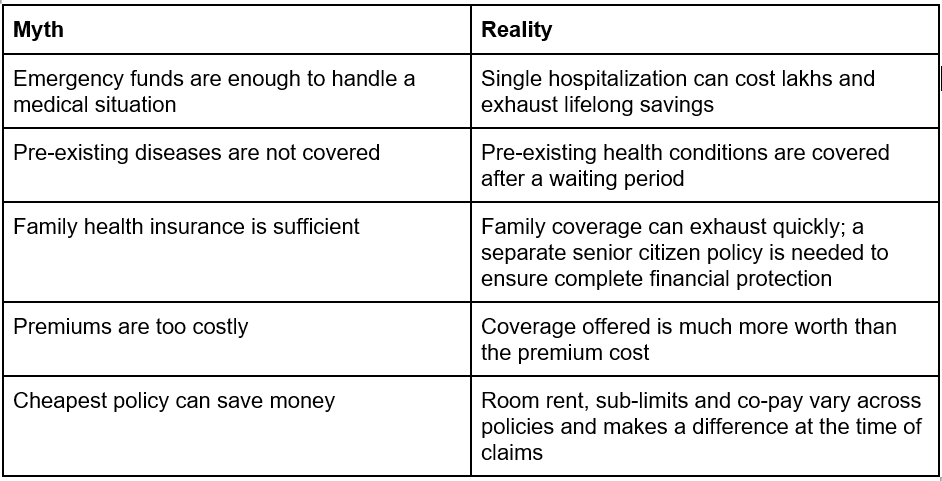
Quick Recap: Myth vs Reality about Senior Citizen Health Insurance
Final Verdict
Getting insurance for your senior citizen parents is not just a financial decision; it is a way of showing they matter. It also ensures that your entire family’s finances are protected in case of a medical emergency.
If you are about to buy or renew a senior citizen health insurance policy for your parents, it is important to clear your doubts and unlearn the myths about senior citizen health insurance to make an informed decision. Thoroughly compare the policy terms and coverage benefits. Make a decision based on facts, not on myths and rumours.
Author

DocIndia Editorial Team
Check cache DocIndia Editorial Team works with Doctors to create informative articles.
View profile