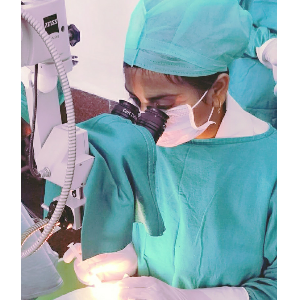
What Is Cataract Surgery and Refractive Lens Exchange?
Cataract surgery and refractive lens exchange are eye procedures in which the natural lens of the eye is removed and replaced with an artificial intraocular lens (IOL) to improve vision. Both procedures are very similar in technique but differ in purpose.
In cataract surgery, the natural lens becomes cloudy due to aging, leading to blurred vision. In refractive lens exchange (RLE), the lens is clear but is replaced to correct vision problems like nearsightedness, farsightedness, astigmatism, or presbyopia.
Both procedures aim to restore clear vision and reduce dependence on glasses or contact lenses.
Purpose & Benefits of Cataract Surgery and RLE
● Restores clear vision by replacing the natural lens
● Treats cataracts or refractive errors
● Reduces dependence on glasses or contact lenses
● Corrects nearsightedness, farsightedness, astigmatism, and presbyopia
● Improves quality of life and daily functioning
● Provides long-term vision correction solution
Who May Need Cataract Surgery or Refractive Lens Exchange?
● Patients with cataracts causing blurred or cloudy vision
● Individuals with age-related vision decline (presbyopia)
● People with high refractive errors not suitable for LASIK
● Patients struggling with glasses or contact lenses
● Individuals with difficulty driving or reading due to poor vision
● People seeking permanent vision correction options
Types of Intraocular Lenses (IOLs) Used
1. Monofocal IOLs
Provide clear vision at one distance (near or far), often requiring glasses for other tasks.
2. Multifocal IOLs
Allow clear vision at multiple distances, reducing dependence on glasses.
3. Toric IOLs
Used to correct astigmatism along with cataract or refractive errors.
4. Extended Depth of Focus (EDOF) IOLs
Provide a continuous range of vision, especially for distance and intermediate vision.
Cataract Surgery and RLE Procedure: Step-by-Step
● Eye is numbed using local anesthetic drops
● A small incision is made in the cornea
● Natural lens is broken into small pieces using ultrasound (phacoemulsification)
● Lens fragments are removed from the eye
● A new artificial IOL is inserted into the lens capsule
● The incision closes naturally without stitches
● Eye is covered with a protective shield
The procedure usually takes about 15 to 30 minutes per eye and is done on an outpatient basis.
Recovery & Aftercare
Most patients can go home the same day after surgery. Vision may be blurry for a few days as the eye heals.
Patients are advised to use prescribed eye drops, avoid rubbing the eye, and protect it from dust or injury. Normal activities can usually be resumed within a few days, while full recovery may take a few weeks.
Follow-up visits are important to monitor healing and ensure proper lens positioning.
Risks & Possible Complications
● Eye infection
● Inflammation or swelling
● Dry eyes
● Glare or halos around lights
● Retinal detachment (rare)
● Lens dislocation or visual disturbance
● Temporary blurred vision
Although complications are rare, both procedures are generally safe and widely performed.
Cataract Surgery vs Refractive Lens Exchange
Cataract surgery is performed when the natural lens becomes cloudy and affects vision.
Refractive lens exchange is done when the lens is still clear but vision correction is needed due to refractive errors.
Both surgeries use the same technique of replacing the natural lens with an IOL, but the reason for surgery is different.

.png) Ophthalmology
Ophthalmology
 Ophthalmic surgery



.png) Pediatric Ophthalmology
Pediatric Ophthalmology


 Optometry